
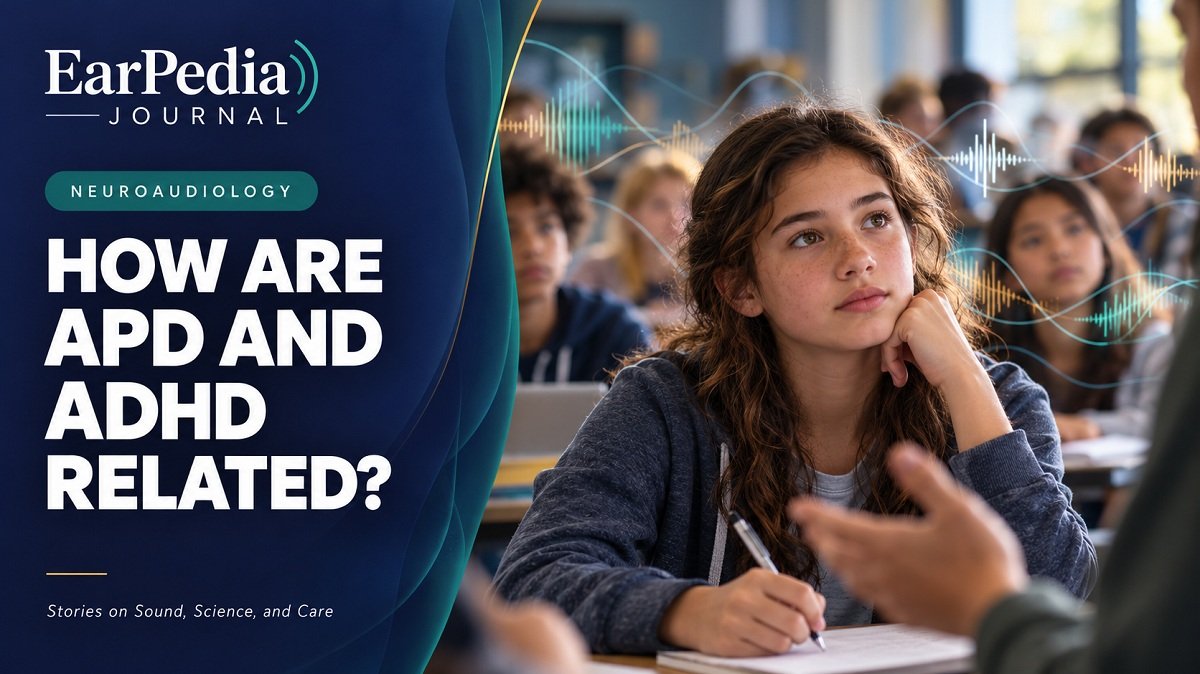
HOW ARE APD AND ADHD RELATED?
Behavioral Symptom Overlap Between APD and ADHD
A significant corpus of research has investigated the parallels and intersections between APD and ADHD, especially the Predominantly Inattentive subtype of ADHD. Numerous authors have observed that the behavioral signs of the two illnesses can be so analogous that differential diagnosis becomes quite difficult.
Certain researchers contend that the overlap in symptomatology is so significant that the two illnesses might, in effect, be virtually indistinguishable. Some assert that APD and ADHD are distinct developmental diseases that may coexist but originate from different cognitive and brain causes.
Others assert that the lack of definitive diagnostic biomarkers for both conditions necessitates that clinical diagnoses depend significantly on behavioral observations and professional judgment, hence elevating the risk of misinterpretation.
The similarity between the behavioral symptoms of APD and those typically seen in ADHD is indeed remarkable.
Children diagnosed with Auditory Processing Disorder (APD) often have challenges in sustaining attention during auditory tasks, retaining orally delivered information, and efficiently processing spoken language.
They may exhibit inadequate listening abilities, sluggish auditory processing, trouble adhering to multistep verbal directives, and obstacles in both receptive and expressive language areas.
These children frequently have scholastic challenges in verbally mediated domains, including reading, spelling, and writing, and may exhibit behavioral issues such as inattentiveness or noncompliance with instructions.
All of these behaviors are also indicative of children with ADHD, particularly those exhibiting inattentive presentations.
Indeed, as previously delineated in this article, numerous behaviors identified as characteristic of Antisocial Personality Disorder (APD) are also those most commonly linked to Attention Deficit Hyperactivity Disorder (ADHD) in clinical diagnoses.
Executive Function and Neurobiological Differences
Nonetheless, a just behavioral comparison between the two scenarios fails to provide a complete understanding. Upon examining deeper cognitive and neuropsychological frameworks, distinct differences become apparent.
ADHD has been consistently linked to significant impairments in executive functioning (EF), including diminished inhibitory control, deficiencies in verbal and visual working memory, obstacles in maintaining motivation, and difficulties in emotional regulation.
These executive function abnormalities are commonly considered fundamental characteristics of ADHD and frequently play a pivotal role in theoretical frameworks of the disorder.
In contrast, deficiencies in executive functioning are not consistently associated with APD and are not seen as defining traits of the disorder.
ADHD is frequently understood as a condition of the frontal lobes and related brain networks that govern planning, organization, self-regulation, and the execution of goal-oriented behavior.
Auditory Processing Disorder (APD) focuses on the processing of auditory information, with its proposed neurological foundation being circuits that stretch from the brainstem via the thalamus to the temporal cortex.
From this viewpoint, Auditory Processing Disorder (APD) signifies a disturbance in the acquisition and interpretation of auditory stimuli, while Attention Deficit Hyperactivity Disorder (ADHD) denotes more extensive challenges in the regulation and synchronization of cognitive functions.
Consequently, when examining the hypothesized etiology, primary functional deficits, and the associated brain systems, the illnesses significantly diverge.
Comorbidity and Medication Research in APD and ADHD
APD and ADHD Comorbidity Rates
Another method to investigate the association between APD and ADHD is to analyze comorbidity patterns—specifically, whether persons diagnosed with one illness are predisposed to fulfill the diagnostic criteria for the other.
Despite the scarcity of study in this domain, the minimal studies available provide significant insights.
Such investigations can elucidate whether the observed symptom overlap indicates common underlying mechanisms or merely superficial resemblances in external behavior.
Riccio et al. (1994) examined a cohort of children previously diagnosed with auditory processing disorder (APD) and subsequently evaluated them for indications of attention-deficit/hyperactivity disorder (ADHD).
Their findings indicated that 50% of the children satisfied the diagnostic criteria for both disorders.
While this percentage significantly exceeds the prevalence of ADHD in the general community, it remains much below the 100% overlap anticipated if APD and ADHD were fundamentally identical disorders.
This partial, albeit not total, overlap has been a primary reason researchers regard the two illnesses as interconnected yet essentially different.
Effects of ADHD Medication on Auditory Processing
Another avenue of research has investigated the impact of ADHD therapies on auditory processing skills.
In four studies investigating the effects of stimulant medicine, three indicated enhancements in certain auditory processing tasks.
Nonetheless, these investigations had significant methodological deficiencies, constraining the robustness of their conclusions.
A more comprehensive investigation revealed that Ritalin enhanced performance solely on an auditory continuous performance test, but not on other auditory processing assessments.
The existing evidence indicates that stimulant medication improves auditory performance mainly on tasks that require significant attentional resources.
This further corroborates the perspective that APD and ADHD possess overlapping attentional characteristics while being distinct clinical entities.
In conclusion, both empirical evidence and theoretical analysis reveal that APD and ADHD exhibit significant overlap in comorbidity rates, behavioral manifestations, and response to attention-enhancing medications; nonetheless, each illness also possesses distinct, defining traits.
This poses a pertinent inquiry for clinicians: if a child exhibits solely the signs common to both diseases, why is an ADHD diagnosis frequently favored?
Diagnostic Evidence and Clinical Interpretation
The response primarily depends on the robustness of the evidence foundation.
In comparison to APD, ADHD possesses a far broader and better substantiated scientific basis.
ADHD symptoms may be accurately assessed, are consistently associated with functional impairment across various life domains, and exhibit significant heredity.
Neurobiological disparities in brain shape and function are extensively documented, and the condition consistently responds to treatments that target catecholaminergic systems.
Notably, certain animal models effectively replicate ADHD-like traits, hence facilitating study into the underlying mechanisms and potential treatments.
The literature on APD is fragmentary and inconclusive.
There are no reliable prevalence estimates, no clearly defined etiological routes, and no therapies corroborated by numerous independent investigations.
Antisocial Personality Disorder (APD) is absent from the Diagnostic and Statistical Manual of Mental Disorders (DSM), and there exists no universally acknowledged diagnostic criteria.
While numerous professional studies and consensus publications give information, they lack diagnostic standards equivalent to those in the DSM.
Consequently, doctors are typically advised to assess and exclude ADHD before to contemplating APD.
Clinical Comparison and Referral Recommendations
Table 1 endeavors to encapsulate characteristics that are either common to both illnesses or more prominently linked to one over the other.
Certain features are derived from the survey results of Chermak et al. (2002), but others are from clinical literature detailing each illness.
The table serves merely as a general reference rather than a conclusive diagnostic criteria.
Many of the common symptoms—such as distractibility, inattention, and inadequate listening—are more apparent and thus more often reported, potentially leading to diagnostic ambiguity during first clinical assessments.
The second section of the table delineates distinct characteristics, underscoring auditory-specific impairments in APD compared to the more extensive behavioral, organizational, and regulatory challenges observed in ADHD.
These disparities inherently result in pragmatic evaluation suggestions.
Table 2 delineates assessment procedures that assist clinicians in distinguishing between the two illnesses or deciding when to send for expert examination.
If a child exhibits inadequate self-regulation in various environments, encounters difficulties in peer interactions, is persistently disorganized, seldom completes assignments, neglects to submit homework, mismanages time, yet achieves satisfactory results on cognitive, academic, and auditory processing assessments, a referral for an ADHD diagnostic evaluation is justified.
If a child has a history of otitis media, struggles in noisy environments, often needs repetition despite being attentive, regularly misinterprets verbal instructions, performs poorly on auditory and language assessments—including verbal short-term memory—and excels in visual tasks and those without oral directions, a referral to an audiologist for comprehensive APD testing is warranted.
Clinicians conducting comprehensive psychoeducational evaluations can utilize the procedures outlined in Table 2 to assist in selecting pertinent measures.
This paper’s comparisons are designed to assist doctors in making educated and precise decisions regarding children whose symptoms obscure the distinctions between ADHD and APD.
Table 1
| ADHD Symptoms | APD Symptoms | Overlapping Symptoms |
|---|---|---|
| Diagnosis can be made by a psychologist or a physician | Diagnosis is typically made by an audiologist | Distractibility |
| Distracted by stimuli | Distracted by noise | Inattention |
| Deficit in focused and/or sustained attention | Deficit in focused attention and filtering background noise | Poor listening skills |
| Attention deficits supramodal | Attention deficits specific to auditory modality | Restlessness |
| Highly impulsive | Less impulsive | Frequently asks to have directions repeated |
| No problems with sound localization | Poor sound localization | Academic difficulties |
| Error-prone in math; poor reading comprehension and writing | Poor phonological decoding & listening comprehension | Difficulty following directions |
| Tendency toward false alarms on auditory CPT | Tendency to miss targets on auditory CPT | |
| Auditory input in the CNS is intact, with deficits primarily in the frontal-striatal area. | Auditory deficit in the CNS |
Table 2
| Method/Measure | Purpose |
|---|---|
| History | ADHD is highly heritable; no data on APD |
| Parent interview | ADHD has more behavioral and EF symptoms & poor planning, organization, and self-control; APD needs directions repeated |
| Parent/teacher behavior rating scales | Elevated Total problems scale for ADHD |
| ADHD rating scales | ADHD has significant elevations in one or more areas; APD could have elevations on the Inattentive scale or remain subthreshold |
| Executive Function scales | ADHD in the clinical range, especially in Inhibition; APD may have elevated Verbal Working Memory |
| Cognitive testing | Normal range IQs for both; APD often have low Digit Span forward |
| Auditory/visual processing tests | APD deficient on auditory only; ADHD okay if attention controlled |
| Academic achievement | Both may have weak reading; ADHD may be weak in math and writing as well. |
| Continuous Performance Tests | ADHD has high false alarms; APD shows omissions on auditory targets |

Discussion
0 Comments
No comments yet
Start the discussion with a question, reflection, or clinical perspective.
Leave a reply
Share a thoughtful response or ask a question about this article.