
Introduction
Tinnitus is a prevalent condition in audiology, impacting millions globally and presenting challenges to physicians due to its variability. Tinnitus, commonly known as a “phantom sound,” is the awareness of noise in the absence of an external cause. For certain people, it is a minor inconvenience; for others, it constitutes a transformative condition linked to sleep disturbances, anxiety, depression, and diminished quality of life.
Notwithstanding its commonality, tinnitus continues to be a complex and varied condition. For audiologists and hearing specialists, a comprehensive understanding of its definitions, mechanisms, and classifications is essential. This fundamental information facilitates diagnosis and communication, informs treatment planning, and establishes a basis for satisfactory patient counseling.
Descriptions of tinnitus can be traced to ancient Egyptian and Greek medical books; nevertheless, scientific research has elucidated the neurophysiological foundations of this illness only in recent decades. Currently, tinnitus is perceived not just as an otologic symptom but also as a consequence of dynamic interactions between auditory and non-auditory brain systems. Comprehending these interconnections is essential for physicians seeking to deliver evidence-based care.
This article examines tinnitus from various perspectives: definitions, epidemiology, causes, and clinical classifications, with particular focus on their practical significance for audiologists.
1. What Is Tinnitus? Definitions and Distinctions
Tinnitus is the perception of sound in the absence of an external stimulation. Patients frequently characterize it as ringing, buzzing, hissing, clicking, or whistling in one or both ears, or even “within the head.” Tinnitus is not a sickness; it is a symptom indicative of underlying auditory or neurological alterations. This distinction prompts clinicians to consider tinnitus not merely as an isolated issue but also as a possible indication of more extensive pathology.
Tinnitus versus Tinnitus Disorder: Recent consensus documents advocate for distinguishing between tinnitus (the perception) and tinnitus disorder (tinnitus associated with distress, emotional dysfunction, or cognitive and behavioral alterations that disrupt quality of life).
Subjective tinnitus is perceived solely by the individual, with no discernible external sound source. Objective tinnitus is uncommon and can be identified by an examiner due to vascular or muscle causes.
Pulsatile versus Non-Pulsatile: Pulsatile tinnitus is rhythmic and frequently aligned with the heartbeat, indicating potential vascular pathology. Non-pulsatile tinnitus is characterized by a continuous or variable sound that is not associated with the heartbeat.
Acute tinnitus persists for less than three months. Chronic tinnitus endures for over three months and can persist for years, frequently involving the central nervous system.
2. Epidemiology and Clinical Burden
Population studies estimate that 10–15% of adults experience tinnitus, whereas 1–3% report severe, debilitating tinnitus. The prevalence escalates with age and cumulative noise exposure; nevertheless, the increasing occurrence among younger people has been ascribed to recreational noise exposure.
Risk factors encompass auditory impairment (presbycusis, noise-induced), ototoxic pharmaceuticals (aminoglycosides, cisplatin), systemic ailments (hypertension, diabetes, cranial trauma), somatic issues (TMJ, cervical spine problems), and psychological distress (anxiety, depression).
The effect on quality of life: Distress is not directly related to loudness but rather to cognitive and emotional reactions. Prevalent impacts encompass insomnia, diminished attention, irritation, depression, and decreased productivity. The socioeconomic burden is significant, with annual expenses for severe tinnitus amounting to thousands of euros per patient in Europe, attributable to healthcare consumption and diminished productivity.
3. Mechanisms of Tinnitus: From Cochlea to Cortex
Peripheral processes encompass cochlear impairment, specifically outer hair cell malfunction and cochlear synaptopathy (concealed hearing loss). Deafferentation induces hyperactivity in the dorsal cochlear nucleus.
Central Gain and Hyperactivity: Diminished peripheral input leads to compensatory enhancements in central auditory gain. Excessive amplification results in aberrant synchronization and hyperactivity, manifesting as tinnitus.
Neuroimaging studies indicate cortical remodeling in the auditory cortex, characterized by an overrepresentation of frequencies near to areas of hearing loss.
Predictive Coding: Computational models suggest that tinnitus results from prediction mistakes when the brain creates phantom percepts to compensate for missing auditory input.
The limbic system attributes negative valence, heightening suffering. Attention networks maintain tinnitus consciousness. Somatosensory signals from the cervical spine and temporomandibular joint can influence tinnitus intensity.
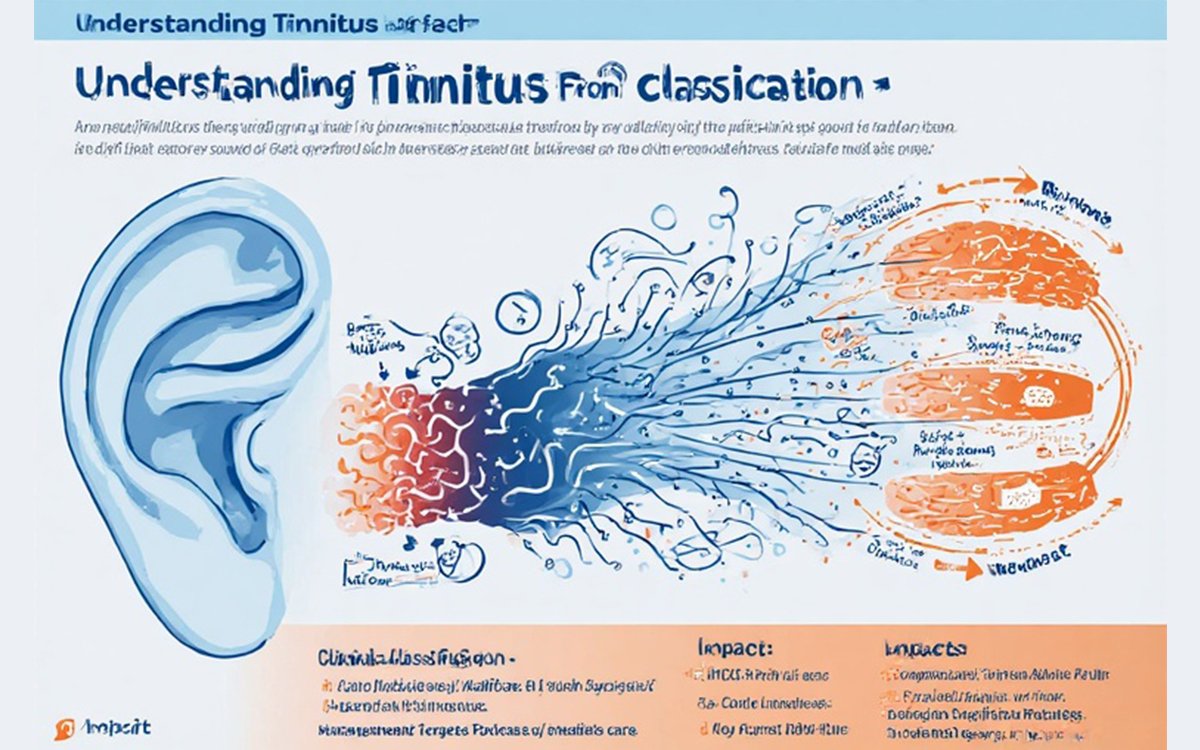
4. Clinical Classifications of Tinnitus
Etiological classification distinguishes primary (idiopathic) tinnitus from secondary tinnitus due to identifiable pathologies (e.g., vascular lesions, vestibular schwannoma).
Temporal classification divides cases into acute (<3 months), subacute (3–12 months), and chronic (>12 months).
Phenomenological classification categorizes tinnitus as tonal vs. noise-like, pulsatile vs. continuous, and intermittent vs. constant.
Functional classification separates compensated tinnitus (minimal interference) from decompensated tinnitus (significant distress).
Clinical Scales: The Tinnitus Handicap Inventory (THI), Tinnitus Functional Index (TFI), and Visual Analog Scales (VAS) are validated tools for quantifying severity and treatment response.
5. Why Definitions and Classifications Matter in Practice
Etiological classification differentiates primary (idiopathic) tinnitus from secondary tinnitus resulting from specific diseases (e.g., vascular lesions, vestibular schwannoma).
Temporal classification categorizes cases as acute (<3 months), subacute (3–12 months), and chronic (>12 months).
Phenomenological classification distinguishes tinnitus into tonal versus noise-like, pulsatile versus continuous, and intermittent versus constant types.
Functional classification distinguishes between compensated tinnitus (low interference) and decompensated tinnitus (severe suffering).
Clinical Scales: The Tinnitus Handicap Inventory (THI), Tinnitus Functional Index (TFI), and Visual Analog Scales (VAS) are proven instruments for measuring severity and therapy efficacy.
6. Future Directions in Tinnitus Research and Management
Novel therapies encompass neuromodulation methods, including repetitive transcranial magnetic stimulation (rTMS) and transcranial direct current stimulation (tDCS). Bimodal stimulation, integrating auditory and somatosensory input, is now undergoing clinical studies.
Pharmacological research investigates potassium channel modulators, NMDA receptor antagonists, and neuroprotective agents. Digital treatments provide cognitive behavioral therapy and tinnitus retraining therapy via smartphone applications. Artificial intelligence is progressively employed for the personalization of sound therapy and the remote monitoring of patient results.
7. Key Takeaways for Audiologists
– Tinnitus is a symptom, not a disease; distinguish tinnitus from tinnitus disorder.
– Most cases are subjective and non-pulsatile, but clinicians must remain alert for red flags.
– Mechanisms involve cochlear injury, central maladaptive plasticity, and emotional-cognitive systems.
– Classification by etiology, time course, sound quality, and functional impact guides management.
– Emotional and attentional systems modulate distress, underscoring the importance of counseling and multidisciplinary care.
Conclusion
Tinnitus is a multifaceted auditory and neuropsychiatric condition, indicative of dysfunctional connections between auditory and non-auditory neural systems. For audiologists, comprehending its definitions, mechanisms, and classifications is crucial for precise diagnosis, effective patient counseling, and evidence-based therapy planning.
Emerging medicines, like neuromodulation and AI-driven interventions, have the potential for enhancing patient outcomes. Audiologists are pivotal in implementing these advancements in clinical practice, guaranteeing that patients comprehend their situation and obtain thorough support to enhance their quality of life.
Leave a reply
Lets Talk.
Related Articles
31
Dec
Sound Therapy in Tinnitus
Introduction Tinnitus is among the most formidable conditions faced by audiologists. For certain patients, it constitutes a negligible background noise that may be disregarded. For some...
Know More >Introduction Tinnitus is not solely an auditory occurrence. Contemporary research increasingly characterizes it as a multisystem disorder encompassing cognitive, emotional, and physiological networks. Among the several...
Know More >30
Dec
Hearing Aids and Tinnitus
Introduction Tinnitus is a multifaceted auditory and neurological disorder defined by the perception of sound without an external source. Despite manifesting as ringing, buzzing, hissing, or...
Know More >
0 Comments
Leave a comment