
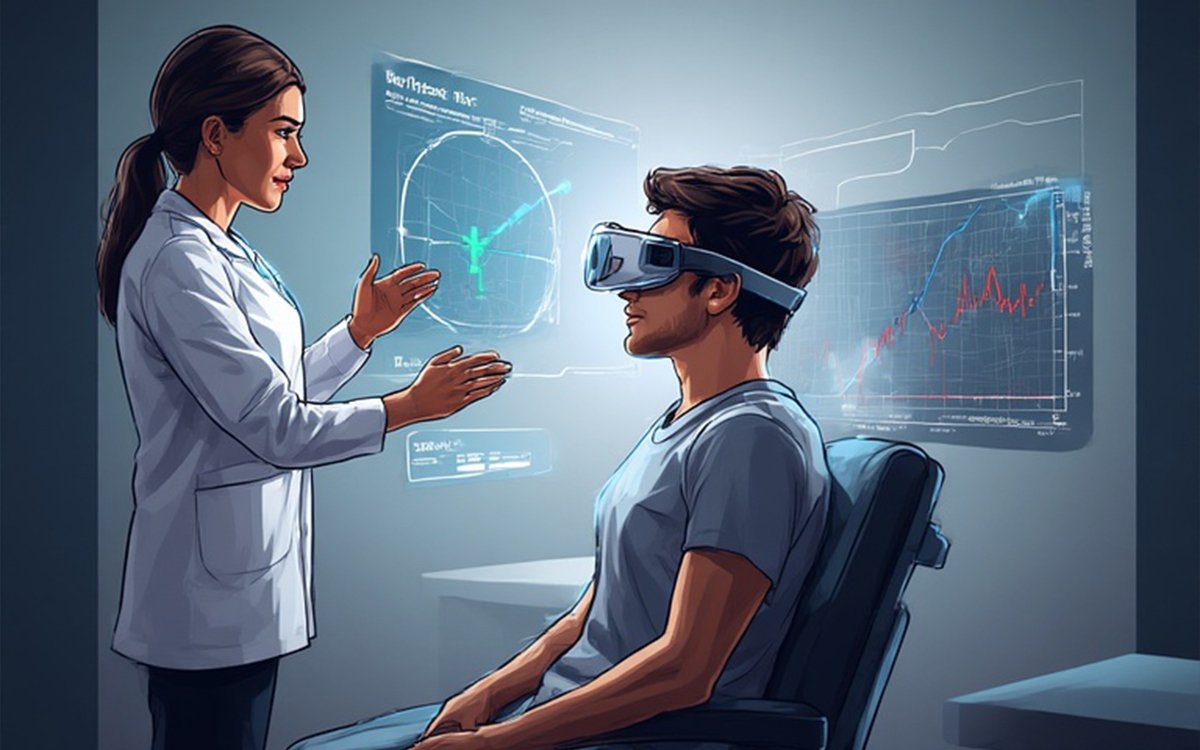
The Video Head Impulse Test (vHIT) is a diagnostic instrument employed to evaluate the functionality of the vestibulo-ocular reflex (VOR), which maintains visual stability during head movements. It is frequently utilized in the assessment of vestibular system diseases, especially those impacting the semicircular canals of the inner ear.
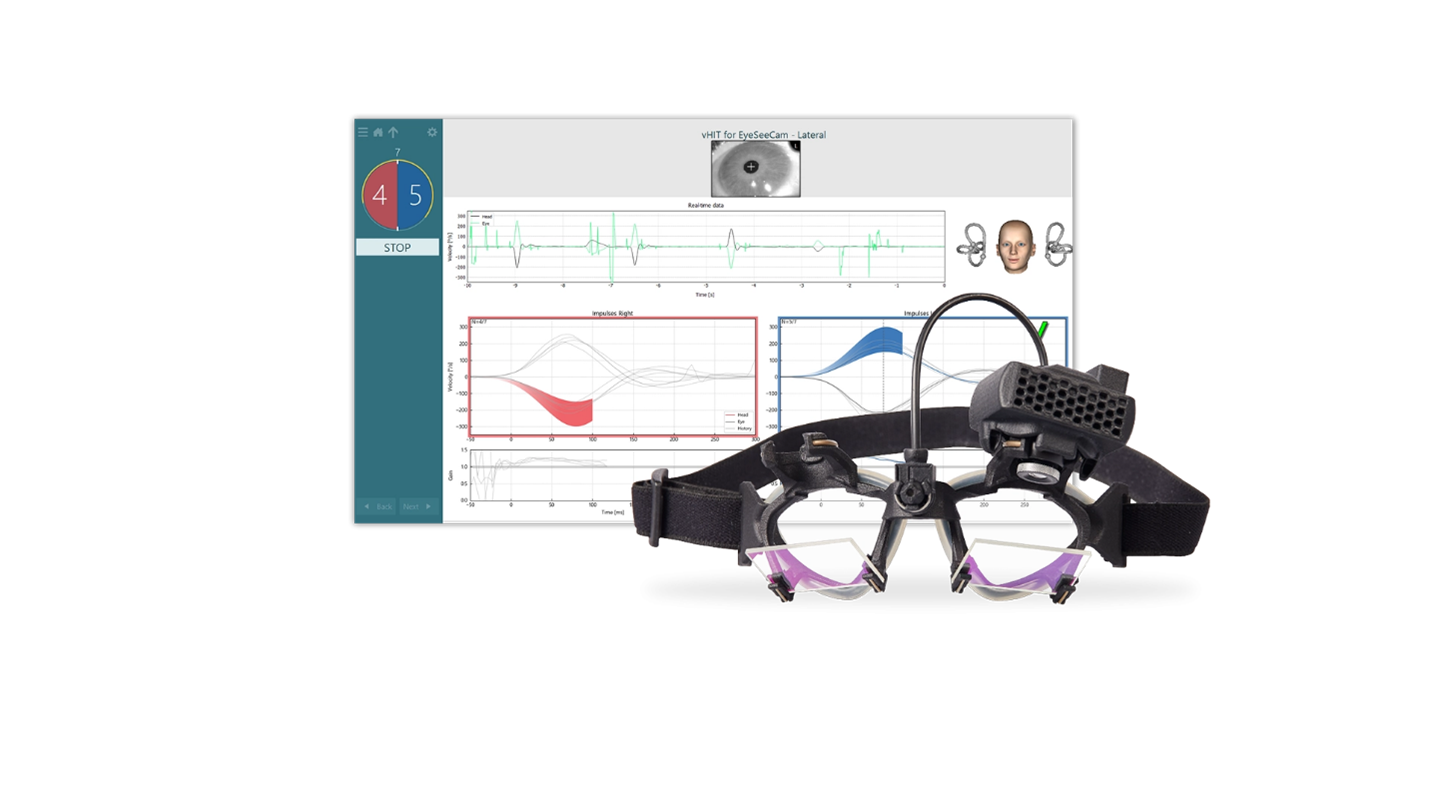
How It Works
- Setup:
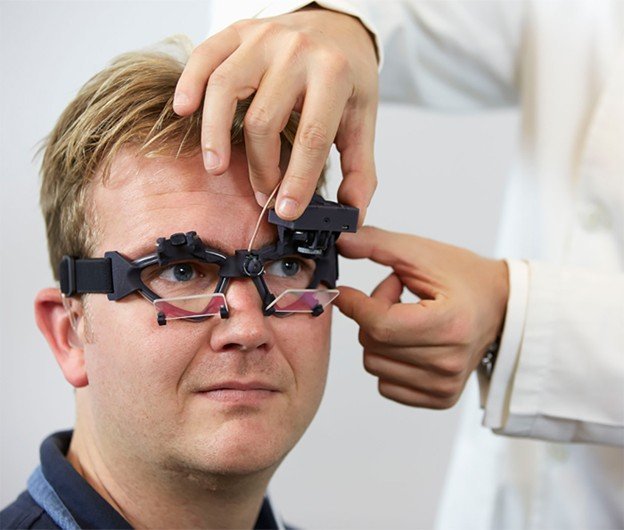
– The patient wears a pair of lightweight, high-speed video goggles equipped with a camera to record eye movements and sensors to monitor head movements.
– The test is conducted in a seated position, typically in a quiet room.
- Procedure:
– The examiner moves the patient’s head in quick, small, and unpredictable angular movements (head impulses) in different directions corresponding to the planes of the semicircular canals (horizontal, anterior, and posterior).
– The patient is instructed to fixate on a stationary target (e.g., a dot or cross on a screen) during the head movements.
- Data Collection:
– The system records eye movements and compares them to head movements in real-time.
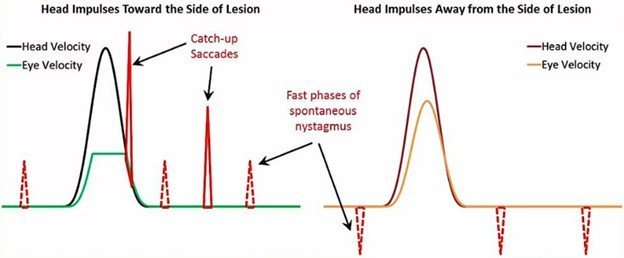
– A healthy VOR will result in the eyes maintaining focus on the target, despite head movements.
– In cases of vestibular dysfunction, the eyes may fail to maintain fixation, necessitating corrective movements called saccades.
Key Metrics
– Gain: The ratio of eye movement velocity to head movement velocity. A normal gain is close to 1, indicating that the eyes move in proportion to head movements.
– Overt Saccades: Large corrective eye movements visible to the naked eye.
– Covert Saccades: Smaller, faster corrective eye movements that occur during head movement and are detectable only with specialized equipment.
Clinical Applications
– Diagnosing Vestibular Disorders:
– Unilateral or bilateral vestibular hypofunction.
– Disorders affecting specific semicircular canals.
– Monitoring Recovery:
– After vestibular neuritis, surgery, or trauma.
– Differentiating Central vs. Peripheral Vestibular Lesions:
– vHIT can help distinguish between disorders caused by inner ear dysfunction (peripheral) and those originating in the brainstem or cerebellum (central).
Advantages
– Non-invasive and quick to perform.
– Can be conducted in various clinical settings.
– Provides objective, quantitative data.
– Detects dysfunction in individual semicircular canals.
Limitations
– May not identify subtle dysfunction in cases of central vestibular disorders.
– Not a replacement for comprehensive vestibular testing (e.g., caloric testing or VNG).
The vHIT is frequently utilized in conjunction with other assessments, such as videonystagmography (VNG) or caloric testing, to deliver a comprehensive evaluation of vestibular function.
Leave a reply
Lets Talk.
Related Articles
31
Dec
Sound Therapy in Tinnitus
Introduction Tinnitus is among the most formidable conditions faced by audiologists. For certain patients, it constitutes a negligible background noise that may be disregarded. For some...
Know More >Introduction Tinnitus is not solely an auditory occurrence. Contemporary research increasingly characterizes it as a multisystem disorder encompassing cognitive, emotional, and physiological networks. Among the several...
Know More >30
Dec
Hearing Aids and Tinnitus
Introduction Tinnitus is a multifaceted auditory and neurological disorder defined by the perception of sound without an external source. Despite manifesting as ringing, buzzing, hissing, or...
Know More >
0 Comments
Leave a comment