
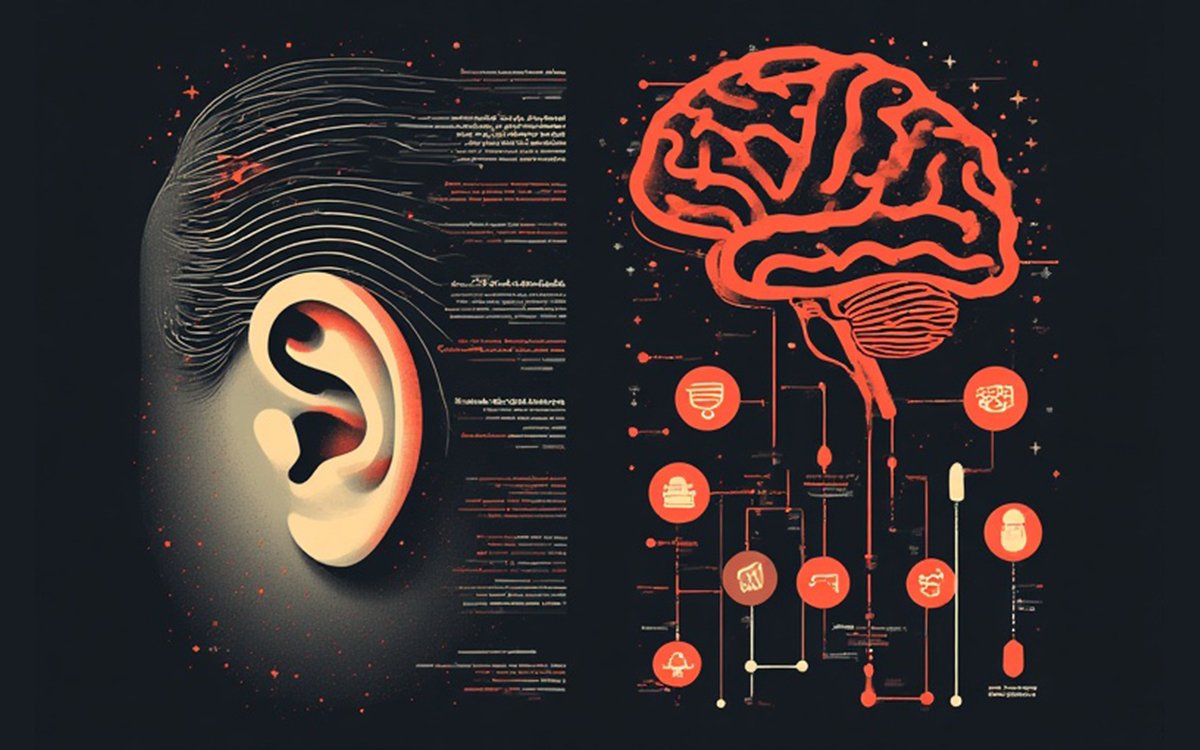
The central auditory circuit demonstrates significant intrinsic redundancy, increasing from the periphery to the cortex. The inferior colliculus comprises roughly 250,000 fibers, nearly tenfold the quantity present in the auditory nerve. Therefore, a localized lesion or dysfunction in the central auditory nerve system is unlikely to be reflected in pure-tone threshold assessments. Significant processing transpires along the route from the auditory nerve to the cortex, both hierarchically—via successive relay stations—and in parallel, as information is conveyed through several channels concurrently. The auditory cortex is essential for the recognition and categorization of auditory inputs, as well as for organizing procedural activities that integrate perceptual processing. Although the cochlea is structurally developed at birth, the maturation and myelination of the rest of the auditory system persist well into later stages of development, advancing from the periphery to the cortex. This developmental process is seen in age-related alterations in auditory evoked potentials and enhancements in behavioral central auditory performance in typically developing youngsters. The pace of myelination differs among people in the typical population and is affected by auditory experience.
Brain Plasticity
The brain possesses an intrinsic capacity for adaptation, with sensory representations modifying in reaction to experience, learning, or altering stimuli. Stimulation and deprivation can alter synapse quantity and density in both developing and mature brains. Plasticity encompasses neurochemical, physiological, and anatomical factors, frequently manifested in behavior. It is typically classified into three categories: developmental, compensatory (post-injury), and learning-related, with the last being particularly task-specific. In auditory processing disorder (APD), training might involve all three modalities. Timely diagnosis and treatments are crucial, as neuroplasticity is most pronounced in younger individuals.
Intervention: Test-Driven or Profile-Driven
Current therapies for auditory processing disorder (APD) are often deficit-specific, targeting primary impairments via a bottom-up strategy, while associated objectives, including language, learning, and communication, are facilitated by top-down tactics. In this context, “bottom-up” denotes the process of decoding acoustic input into significant auditory signals, while “top-down” entails employing past knowledge and context to understand messages.
Auditory training can be executed through two primary methods. A test-driven methodology identifies training tasks based on specific test outcomes, whereas a profile-driven methodology categorizes children into APD subtypes, such as the Bellis/Ferre or Buffalo Models, and customizes interventions appropriately. The Bellis/Ferre paradigm delineates three principal APD characteristics, each necessitating distinct training methodologies.
Auditory Decoding Deficit Profile
This profile is characterized by challenges in distinguishing subtle acoustic variations in speech, frequently resembling the manifestation of peripheral hearing loss. Diagnostic characteristics encompass deficiencies in monaural separation and closure, evidenced by subpar performance on low-redundancy speech assessments, monaural competing signal tasks, and gap detection evaluations.
Related consequences may encompass issues in auditory comprehension among background noise, challenges in reading and spelling, and deficient phonological decoding abilities. Intervention options generally encompass pre-teaching vocabulary and concepts, using visual or multimodal clues, reiterating rather than rephrasing information, phoneme training, and employing compensatory measures to improve listening and auditory closure. Speech and language treatment is advised when needed to tackle phonological and comprehensive language deficiencies.
Prosodic Deficit Profile
This profile is characterized by challenges in utilizing prosodic aspects of speech and exhibiting subpar performance in auditory patterning and temporal ordering tasks. In contrast to other profiles, auditory perception in noisy environments is typically preserved. Affected individuals find it challenging to identify stress, rhythm, and intonation, resulting in frequent misunderstandings, diminished perception of communicative meaning, and impaired rhythm, musical, or vocal abilities.
Intervention tactics prioritize the enhancement of prosodic cues by utilizing expressive educators, multimodal resources, and explicit, straightforward language. Supplementary techniques encompass temporal patterning and prosody training, reading aloud with heightened intonation, and compensating tactics to enhance social communication, intent recognition, and conversational repair. When necessary, additional interventions such as pragmatic therapy, visual assistance, or specialized instruction (e.g., in mathematics) may be suitable.
Integration Deficit Profile
This profile is marked by challenges in tasks necessitating intersensory or multisensory integration. Individuals frequently demonstrate deficiencies in binaural separation (e.g., competing sentences) and binaural integration (e.g., dichotic digits), along with subpar performance on auditory pattern assessments in verbal reporting contexts.
Sequelae frequently encompass difficulties with interhemispheric integration, particularly in synthesizing prosodic and linguistic components to achieve comprehensive sentence comprehension. Visual or multimodal stimuli may exacerbate confusion, as impacted individuals find it challenging to integrate information efficiently.
Intervention options emphasize enhancing acoustic access, minimizing multimodal inputs, and delivering specialized training for prosody, interhemispheric functions, and binaural separation/integration. Compensatory strategies encompass promoting active listening and engaging advanced language and cognitive abilities. Supplementary assistance, like occupational therapy or specialized tutoring, may be necessary based on related challenges.
| Profile | Key Features | Sequelae | Intervention Strategies |
| Auditory Decoding Deficit | Difficulty discriminating fine acoustic details; resembles peripheral hearing loss; deficits in monaural separation/closure and gap detection. | Problems hearing speech in noise, reading/spelling difficulties, weak phonological decoding. | Pre-teaching vocabulary, visual/multimodal cues, repeating (not rephrasing), phoneme training, speech-language therapy. |
| Prosodic Deficit | Impaired use of prosody; poor auditory patterning and temporal ordering; hearing in noise intact. | Difficulty perceiving stress, rhythm, intonation; misunderstandings; weak rhythm/music skills. | Use expressive teachers, multimodal supports, clear language, prosody training, reading aloud with exaggerated intonation, and pragmatic/academic support. |
| Integration Deficit | Deficits in multisensory/interhemispheric tasks; poor binaural separation/integration; weak synthesis of information. | Difficulty integrating prosodic and linguistic cues; confusion with multimodal inputs. | Improve acoustic access, reduce multimodal cues, prosody/interhemispheric/binaural training, compensatory listening strategies, occupational/academic support. |
The Buffalo Model
The Buffalo Model categorizes auditory processing disorder (APD) into four categories, with therapeutic options customized to address the distinct impairments of each group.
- Decoding Subtype
- Features: Difficulty synthesizing or analyzing speech units (e.g., sounds into words, words into phrases).
- Sequelae: Problems with word interpretation, spelling, and reading.
- Intervention: Training in phonological awareness skills.
- Tolerance-Fading Memory Subtype
- Features: Weak short-term auditory memory; difficulty recalling word lists or multi-step instructions.
- Sequelae: Poor performance in noisy environments due to reduced noise tolerance.
- Intervention: Memory-building strategies and training to improve tolerance to background noise.
- Organization Subtype
- Features: Difficulty sequencing auditory information, such as retelling stories in order.
- Sequelae: Problems structuring language and recalling sequential information.
- Intervention: Language-based activities that emphasize the sequencing of ideas and facts.
- Integration Subtype
- Features: Difficulty integrating auditory information with other sensory input.
- Sequelae: Challenges in multisensory processing and coordinated comprehension.
- Intervention: Activities requiring attention to multisensory information to strengthen integration skills.
Bellis-Ferre and Katz assert that these profiles may manifest independently or concurrently. Nonetheless, existing evidence substantiating either model is still inadequate.
Buffalo Model: APD Subtypes Summary
| Subtype | Key Features | Sequelae | Intervention Strategies |
| Decoding | Difficulty synthesizing or analyzing speech units (sounds into words, words into phrases). | Problems with word interpretation, spelling, and reading. | Training focused on phonological awareness skills. |
| Tolerance-Fading Memory | Weak short-term auditory memory; difficulty recalling lists or multi-step instructions. | Poor performance in noisy environments; reduced tolerance to background noise. | Memory-building activities; training to improve noise tolerance. |
| Organization | Difficulty sequencing auditory information, e.g., retelling stories in correct order. | Problems structuring language and recalling sequential information. | Language activities emphasizing the sequencing of ideas and facts. |
| Integration | Difficulty integrating auditory input with other sensory information. | Challenges in multisensory processing and coordinated comprehension. | Multisensory training activities to strengthen integration skills. |
Specific Intervention Strategies for APD
Auditory processing disorder (APD) can profoundly impact listening, communication, and academic achievement, frequently coexisting with language and learning challenges. Consequently, intervention must be comprehensive and incorporate a multidisciplinary team. When devising management strategies, it is important to consider factors such as linguistic proficiency, attentional capacity, and memory retention.
Due to the significant heterogeneity of APD, therapies must be tailored to the individual rather than applied universally. Intervention techniques can be classified into five distinct categories:
- Environmental modifications
- Signal enhancement strategies
- Teacher/speaker adaptations
- Formal and informal auditory training
- Compensatory strategies
Environmental Modifications
In inadequate acoustic settings, the interplay of noise and reverberation impairs speech perception by obscuring critical components, distorting temporal signals, and diminishing speech energy with distance. Prevalent sources of noise in classrooms encompass HVAC systems, vehicular traffic, neighboring classrooms, and student engagement.
Standards:
- UK regulations specify that unoccupied classroom noise should not exceed 35 dB(A), with reverberation times ≤ 0.4 s (125–4000 Hz) in primary schools and ≤ 0.8 s in secondary schools.
- Reverberation, caused by multiple reflections of sound, prolongs and distorts the speech signal, amplifying background noise and further reducing intelligibility.
Strategies:
- Implement architectural interventions such as acoustic panels, curtains, carpets, and partitions to absorb sound and reduce reverberation.
- Reduce or eliminate competing noise sources where possible to improve the signal-to-noise ratio (SNR).
These adjustments are essential for children with auditory processing disorder (APD), while also improving speech perception for other kids in educational environments.
Age-Related Acoustic Requirements
Permissible classroom noise and reverberation levels differ based on age and auditory capability.
- Adolescents (≥12 years) and young adults with normal speech-in-noise processing can generally tolerate ambient noise up to 40 dB(A) and reverberation times of about 0.5 s.
- Younger children require stricter conditions. For example:
- Around 39 dB(A) for 10–11-year-olds
- As low as 28.5 dB(A) for 6–7-year-olds
- Children with suspected or documented listening difficulties may require levels as low as 21.5 dB(A).
Signal-to-Noise Ratio (SNR):
- For pupils with normal hearing: +15 to +20 dB is acceptable.
- For children with listening deficits (e.g., APD): at least +30 dB SNR is recommended.
- Teacher’s voice should be 33 dB above ambient noise for full consonant audibility.
- A 22 dB advantage is required for complete vowel perception.
In numerous untreated classrooms, the prescribed standards for noise and reverberation are not achieved. Excessive background noise and reverberation adversely affect all pupils, but the impact is most pronounced for those with Auditory Processing Disorder (APD).
Sound-field amplification systems can be employed to enhance speech intelligibility in loud settings. Excessive reverberation cannot be rectified electronically and necessitates alterations to the surroundings.
Effective solutions encompass the utilization of sound-absorbing materials, including acoustic panels, cork boards, rugs, and drapes, alongside the treatment of highly reflective surfaces. In antiquated schools with inadequate acoustic conditions, more comprehensive interventions—such as the installation of partitions or sound-absorbing screens—may be required.
Elementary interventions can also yield substantial benefits, like closing doors, sealing apertures, installing insulated windows, affixing rubber tips to furniture legs, and employing soft coverings on tables. Decreased ceiling heights and enhanced classroom configurations greatly diminish resonance.
Ultimately, performing an acoustic study helps ascertain background noise levels and reverberation times, informing suitable remedial measures to enhance the listening experience.
Furthermore, educators are urged to diminish the physical area utilized during direct instruction, thereby reducing the gap between themselves and the students. This mitigates the degradation of essential speech components as the signal diminishes with distance. Preferential seating is advised, as it enhances children with Auditory Processing Disorder’s access to the teacher’s speech and mitigates the adverse impacts of classroom noise.
Leave a reply
Lets Talk.
Related Articles
31
Dec
Sound Therapy in Tinnitus
Introduction Tinnitus is among the most formidable conditions faced by audiologists. For certain patients, it constitutes a negligible background noise that may be disregarded. For some...
Know More >Introduction Tinnitus is not solely an auditory occurrence. Contemporary research increasingly characterizes it as a multisystem disorder encompassing cognitive, emotional, and physiological networks. Among the several...
Know More >30
Dec
Hearing Aids and Tinnitus
Introduction Tinnitus is a multifaceted auditory and neurological disorder defined by the perception of sound without an external source. Despite manifesting as ringing, buzzing, hissing, or...
Know More >
0 Comments
Leave a comment