
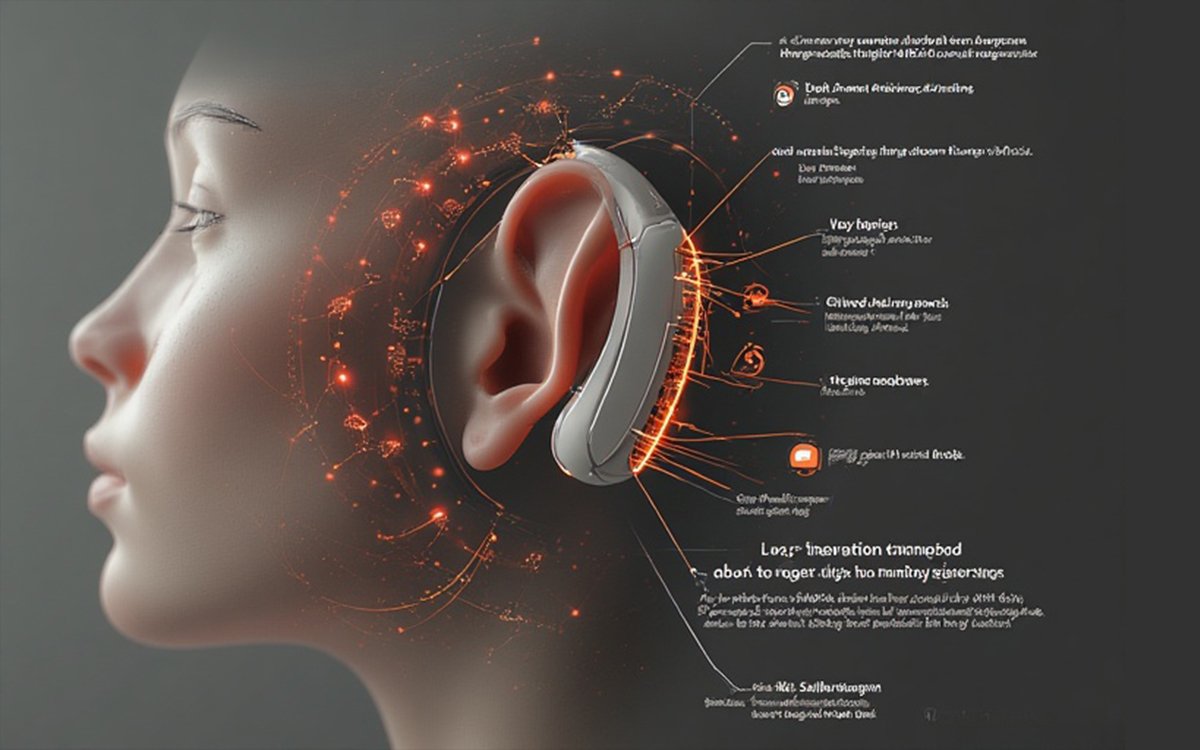
Severe-to-profound hearing loss, generally characterized by a pure-tone average (PTA) of 70 dB HL or above, constitutes one of the most difficult demographics for auditory rehabilitation. In contrast to those with mild or moderate hearing loss, those with severe-to-profound losses face considerable challenges in both audibility and the processing of intricate auditory information. Cochlear implants serve as a significant intervention for substantial hearing loss; nonetheless, both conventional and advanced hearing aids continue to be essential solutions for numerous patients, especially those with residual acoustic hearing or a preference for non-surgical methods. Effectively managing severe-to-profound hearing loss with amplification necessitates meticulous evaluation of physiological, psychoacoustic, and technological elements to enhance audibility, comfort, and speech comprehension.
A major issue in addressing severe-to-profound hearing loss is the markedly diminished dynamic range of hearing. The dynamic range is defined as the disparity between the listener’s threshold of audibility and the unpleasant loudness level (UCL). In persons with severe-to-profound sensorineural hearing loss, this range may be limited to 20–30 dB. Thus, the installation of amplification devices entails not just augmenting volume but also meticulously compressing incoming sound to conform to this restricted perceptual range. Delivering adequate amplification to reestablish audibility without surpassing the UCL necessitates advanced signal processing techniques, frequently integrating both linear and non-linear methods.
Wide dynamic range compression (WDRC) has traditionally been the preferred amplification method for individuals with severe-to-profound hearing loss. By compressing soft, medium, and loud input signals within the limited dynamic range of the listener, WDRC guarantees that soft speech is perceptible while loud sounds remain tolerable. Nonetheless, elevated compression ratios and rapid compression, typically employed to enhance audibility, may alter the amplitude envelope of speech. Such distortions may impair speech quality and diminish intelligibility, which is especially harmful for individuals who already suffer from diminished frequency and temporal resolution. Slow-acting compression, conversely, maintains the amplitude-time configuration of speech but may inadequately enhance the audibility of mild inputs. The optimal strategy typically employs a hybrid method that reconciles the advantages of both rapid and gradual compression, guaranteeing audibility while reducing distortion.
Recent advancements in amplification technology have introduced systems like Dynamic Speech Enhancement (DSEsp) and Speech Guard, which seek to maximize this equilibrium. These systems analyze speech signals in a nearly linear fashion when input levels are consistent, maintaining the inherent temporal and amplitude attributes of speech. Upon abrupt signal alteration, swift compression is implemented to ensure comfort and prevent the output from exceeding the upper control limit (UCL). Through the integration of various methodologies, sophisticated hearing aids can preserve speech intelligibility in diverse auditory settings, simultaneously minimizing the user’s listening effort.
Auditory characteristics in severe to profound hearing loss present distinct obstacles for fitting and signal processing. Frequency resolution is frequently diminished by expanded auditory filters, impairing the capacity to distinguish speech from ambient noise. Temporal resolution, especially at low frequencies, is generally maintained, enabling listeners to utilize temporal cues for speech comprehension. This differential preservation elucidates why individuals with severe-to-profound hearing loss frequently depend significantly on visual signals, such as lip-reading, to augment auditory input in noisy or intricate listening contexts. Amplification techniques must account for the listener’s remaining abilities, optimizing access to temporal cues while enhancing speech audibility.
A crucial factor is the existence of cochlear “dead regions,” wherein hair cells or neuronal components cease to respond to auditory stimuli. Efforts to enhance sounds in these areas may prove futile or detrimental, as excessive amplification might obscure other frequencies or induce acoustic feedback. Advanced fitting processes involve identifying dead regions, enabling doctors to prevent over-amplification in unsuccessful frequency bands while maximizing gain in areas with functional residual hearing. This focused method enhances voice perception while minimizing the likelihood of feedback and discomfort.
Managing feedback is a constant concern in amplification for severe-to-profound hearing loss, as the high-gain levels necessary for audibility elevate the risk of acoustic feedback. Conventional feedback suppression techniques frequently diminish gain in essential speech frequency ranges, undermining audibility. Contemporary methods alleviate this trade-off by dynamically modifying compression thresholds and utilizing adaptive feedback control, ensuring speech signals stay intelligible while reducing undesirable artifacts. For individuals with pronounced high-frequency loss, these tactics are especially crucial, as high-frequency speech cues are frequently the most impaired and concurrently the most vulnerable to feedback.
Directional microphone technology is a crucial element in the care of severe to profound hearing loss. Directional microphones enhance the signal-to-noise ratio (SNR) for frontal speech by diminishing sounds from the sides and rear. This effect can improve speech comprehension in loud settings by as much as 9 dB SNR. Standard directional systems may diminish low-frequency noises that patients with residual low-frequency hearing depend on for environmental awareness and spatial localization. To mitigate this constraint, split-directional or high-frequency directional systems preserve omnidirectional reception at low frequencies while implementing directionality at high frequencies. This sophisticated processing maintains access to essential environmental signals while ensuring voice clarity in difficult acoustic environments.
Clinical research highlights the necessity of customized amplification techniques for this demographic. Research on persons with bilateral, moderate to profound slope sensorineural hearing loss who express dissatisfaction with traditional hearing aids reveals markedly diminished speech comprehension, even in optimally fitting scenarios. The average CNC word recognition in silence varied between 28% and 31%, whereas sentence recognition in noise sometimes fell below 20% at +10 dB SNR. These deficiencies are exacerbated by subjective discontent with auditory performance, impaired functional hearing capacity, and a decreased quality of life. Significantly, several individuals are not consistently recommended for cochlear implant assessment, despite the probability that a bimodal strategy (cochlear implant in one ear and hearing aid in the other) could markedly enhance results. These findings highlight that standard bilateral amplification may be inadequate for individuals with severe-to-profound hearing loss, necessitating prompt referral for advanced therapies.
Verification procedures, including real-ear measurements and aided speech testing, are essential to ensure that prescribed targets are achieved without exceeding UCL or introducing distortion. Validation using self-report scales, such as the Speech, Spatial, and Qualities of Hearing Scale (SSQ) or Health Utilities Index, provides additional insight into the functional benefits of amplification in daily life and informs necessary adjustments.
Even minor alterations in gain, compression, or directional behavior can impact user satisfaction and performance. Counseling and auditory training may further enhance speech perception and listening comfort, particularly in challenging acoustic environments.
Leave a reply
Lets Talk.
Related Articles
31
Dec
Sound Therapy in Tinnitus
Introduction Tinnitus is among the most formidable conditions faced by audiologists. For certain patients, it constitutes a negligible background noise that may be disregarded. For some...
Know More >Introduction Tinnitus is not solely an auditory occurrence. Contemporary research increasingly characterizes it as a multisystem disorder encompassing cognitive, emotional, and physiological networks. Among the several...
Know More >30
Dec
Hearing Aids and Tinnitus
Introduction Tinnitus is a multifaceted auditory and neurological disorder defined by the perception of sound without an external source. Despite manifesting as ringing, buzzing, hissing, or...
Know More >
0 Comments
Leave a comment