
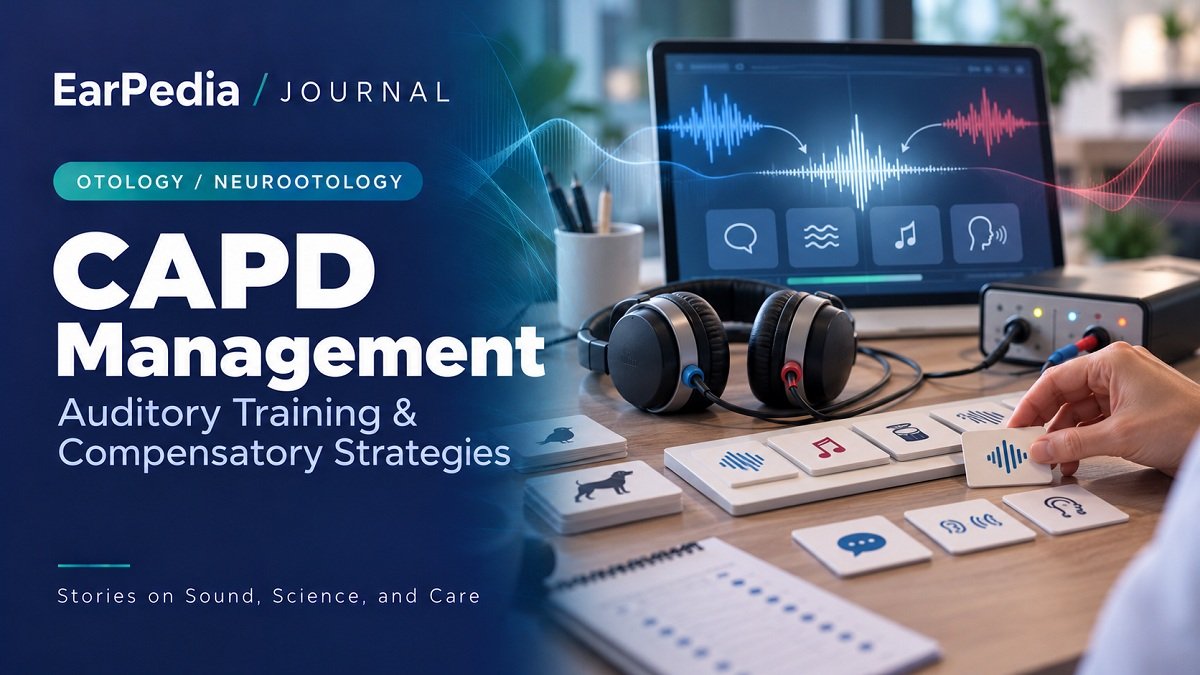
CAPD Management
Informal Auditory Training
Informal auditory training encompasses several activities aimed at enhancing essential auditory systems and processes, such as auditory closure, temporal patterning and prosody, auditory discrimination, dichotic listening, and interhemispheric information transfer. Despite the scarcity of empirical research beyond single-case studies, these training approaches have been extensively applied in educational settings for children. These strategies are considered cost-effective interventions that address fundamental elements of auditory processing.
Auditory Closure Activities
Auditory closure denotes the capacity to comprehend a cohesive and significant entirety despite the absence or deterioration of components within the auditory signal. Individuals with deficiencies in this skill frequently struggle to comprehend speech in low-redundancy settings, such as monaural low-redundancy speech tasks. To tackle these issues, many organized activities may be utilized:
- Missing element exercises:These entail activities where the listener is required to provide a missing word, syllable, or phoneme within a sentence or word, thus exercising the reconstruction of partial verbal information.
- Reduced external redundancy tasks:Engagements like speech-in-noise training or exposure to diverse dialects and intentional misarticulations generate circumstances where segments of the auditory information are concealed. Consequently, learners must depend on auditory closure abilities to deduce the absent information.
- Contextual vocabulary training:This method pushes learners to infer a word’s meaning from its contextual surroundings. The term is subsequently reinforced to enhance both lexical comprehension and auditory closure skills.
The primary objective of auditory closure training is to enhance the listener’s ability to compensate for missing auditory information through active meaning reconstruction. Enhancing this talent improves speech perception in difficult settings and facilitates more effective communication and learning.
Temporal Patterning and Prosody Training
Deficiencies in temporal patterning and prosody are often linked to challenges in auditory timing assessments, including the Frequency Patterns Test and the Duration Patterns Test. Given that temporal processing and prosodic elements of speech—specifically rhythm, stress, and intonation—are essential for efficient communication, focused training in these areas is highly advisable. Structured exercises aim to enhance the awareness and utilization of prosodic cues in spoken language. Typical training activities encompass the following:
- Discrimination of non-speech signals: Learners are asked to make same/different judgments regarding stimuli that differ in acoustic properties such as pitch, stress, loudness, or interstimulus interval. This sharpens sensitivity to temporal and prosodic contrasts.
- Syllabic stress recognition: For example, distinguishing between words like convict (noun) and convict (verb), where stress placement alters word class and meaning.
- Sentence-level stress contrasts: Participants practice identifying subtle differences in stress patterns that shift sentence meaning (e.g., Put the book on the table vs. Put the book on the table).
- Interpreting communicative intent: Activities may include identifying tone of voice, recognizing sarcasm, interpreting the punch line of a joke or story, and differentiating between direct and passive speech.
- Keyword extraction training: Individuals are taught to identify and attend to stressed words in an utterance, as these often carry the primary informational load of the message.
- Reading with prosodic emphasis: Reading aloud with deliberate attention to rhythm, stress, and intonation reinforces the integration of prosodic features into natural speech production.
- Sequencing and patterning tasks: Games such as Simon, which require sequencing tones and light patterns, can enhance auditory sequencing skills. Similarly, reproducing note sequences on a piano—manipulated along parameters such as pitch, duration, or loudness—offers a structured method for strengthening temporal pattern recognition.
These activities collectively seek to improve an individual’s capacity to recognize and utilize prosodic cues in daily conversation. Enhanced sensitivity to rhythm, stress, and intonation not only aids in precise speech perception but also promotes pragmatic comprehension, encompassing the identification of emotional tone and speaker purpose.
Auditory Discrimination Training
Auditory discrimination training aims to assist persons who struggle to differentiate between speech sounds, a difficulty frequently reflected in weaknesses in phonological awareness, phoneme awareness, and speech-to-print abilities. Phonological awareness denotes the ability to recognize and manipulate the fundamental components of language, such as words, syllables, and phonemes. In this continuum, phonemic awareness, particularly the capacity to discern and modify individual phonemes, signifies the highest level of processing.
Phonological awareness is acknowledged as a fundamental aspect of speech-language therapy and is considered one of the most significant indicators of future proficiency in reading and spelling. The advancement of digital learning technology has led to the integration of temporal processing and auditory discrimination training in numerous computer-assisted intervention programs as part of their evidence-based methodologies. Nonetheless, conventional interpersonal activities remain essential in cultivating these skills. Examples of training activities include:
- Phoneme discrimination exercises: Initial tasks focus on distinguishing phonemes (both vowels and consonants) in isolation. As proficiency increases, activities progress toward more complex discrimination tasks involving phonemes within syllables and words (e.g., boots vs. boost, shoulder vs. soldier).
- Phonics and speech-to-print mapping: Learners are guided in associating phonemes with their corresponding graphemes, thereby strengthening the link between auditory processing and orthographic representation.
By consistently enhancing auditory discrimination skills, these therapies immediately increase phonological processing, which is fundamental to reading fluency, spelling accuracy, and overall language and literacy results.
Dichotic Listening Training
Dichotic listening training targets individuals with deficiencies in binaural separation or integration, typically evidenced by subpar performance on dichotic listening tasks. Such challenges can impede the capacity to interpret auditory information efficiently amidst conflicting signals, a skill essential for daily conversation in noisy settings. Interventions in this domain aim to augment auditory attention, refine interaural coordination, and elevate the ability to filter and prioritize auditory stimuli. Examples of representative training activities encompass:
- Informal speech-in-noise training:A proposed method (Schochat, 2002, personal communication) entails utilizing song lyrics to enhance voice perception among background noise. Training should commence with uncomplicated conditions, such as well-known and leisurely tunes delivered by a solo vocalist in the listener’s native accent. The difficulty level is progressively heightened by incorporating quicker songs, diverse dialects, numerous vocalists, and finally, unfamiliar content. After each listening assignment, the learner is prompted to examine the lyrics to evaluate and enhance understanding.
- Informal dichotic training:This strategy necessitates the listener to focus on auditory content delivered to the less proficient ear, as determined by dichotic testing, such as a radio broadcast or an audiobook narrated by a speaker. Concurrently, the dominant ear is subjected to competing auditory stimuli of progressively escalating complexity, beginning with subtle white noise, advancing to symphonic compositions, then lyrical music, and ultimately culminating in spoken content such as television news or dialogue. The difficulty is methodically modified by amplifying the competing signal or diminishing the signal-to-noise ratio.
- Localization training in quiet and noise:Elementary games like Blind Man’s Bluff or Marco Polo can function as effective training techniques for honing aural localization abilities. These activities encourage the listener to utilize spatial cues in both tranquil and cacophonous environments to discern the direction and position of a sound source.
The primary objective of dichotic listening training is to augment an individual’s capacity to differentiate, synthesize, and pinpoint conflicting auditory stimuli, thus facilitating enhanced speech comprehension in intricate auditory settings.
Compensatory Strategies
Compensatory techniques aim to assist individuals in managing remaining auditory processing challenges and to enhance their capacity to utilize auditory information in everyday situations. In contrast to direct repair methods that enhance fundamental auditory processes, compensating solutions seek to furnish practical tools that facilitate effective communication and learning in real-world situations. Various strategic categories have been delineated:
- Active listening:Individuals are instructed to assume the role of active listeners by adopting personal accountability for their listening conduct. Methods like “whole-body listening” underscore that listening is an active endeavor necessitating attention, engagement, and understanding of both verbal and nonverbal signals.
- Auditory vigilance training:This method emphasizes maintaining concentration on aural stimuli. A prevalent technique entails displaying a target stimulus at arbitrary intervals; for example, a parent may narrate a narrative while the child is directed to raise their hand each time a certain target word or sound is uttered. Such exercises promote selective attention and reactivity to auditory stimuli within an uninterrupted flow of information.
- Auditory memory enhancement:Memory is fundamental to auditory processing. Cline differentiates between short-term, long-term, and sequential memory, all of which can be enhanced by specific activities. Musiek proposes employing tools including mental imagery, spatial elaboration, creative processes, and organizational procedures to enhance recall. A functional approach is frequently advocated, enabling children with Auditory Processing Disorder (APD) to retain and recall vital everyday information, such as personal details (telephone number, address), academic sequences (days of the week, months of the year, alphabet), classroom instructions, game rules, and mathematical facts like times tables.
- Auditory directives training:This method, executed in naturalistic or game-like settings, entails providing auditory instructions that necessitate muscular responses. The therapist or parent monitors performance and offers constructive criticism, thus integrating listening with action and reinforcement.
- Metacognitive strategies:These methodologies enhance self-awareness and regulation of listening and comprehension mechanisms. Techniques may encompass self-regulation, problem-solving, mnemonic devices (e.g., acronyms, analogies), visual representations, vocal practice, and re-auditorization. These tactics strengthen individuals’ capacity to manage difficult listening scenarios and mitigate deficiencies in auditory processing by providing cognitive resources.
In summary, compensatory techniques offer individuals adaptive mechanisms to alleviate the functional effects of auditory processing challenges. These methodologies foster autonomy and proficient communication in academic and daily settings through the integration of active engagement, memory enhancement, guided practice, and metacognitive strategies.


Discussion
0 Comments
No comments yet
Start the discussion with a question, reflection, or clinical perspective.
Leave a reply
Share a thoughtful response or ask a question about this article.