
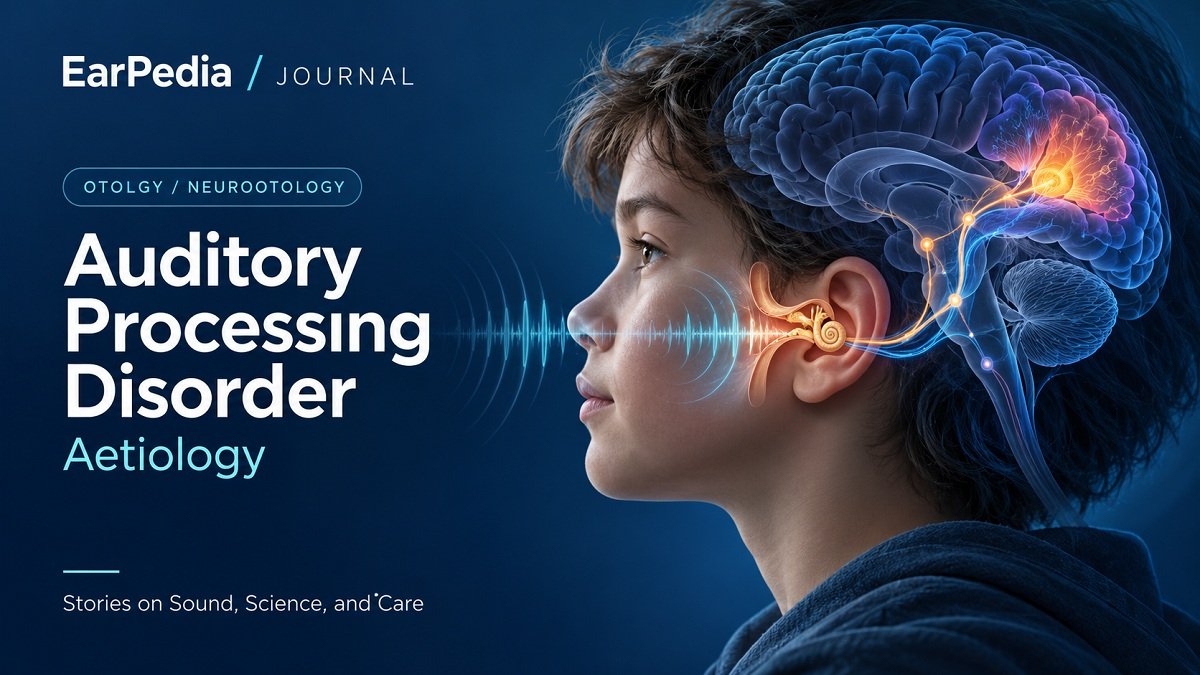
Auditory processing disorder (Aetiology)
Introduction
Auditory processing disorder (APD) is a form of hearing impairment resulting from a dysfunction in the brain region responsible for auditory processing. Auditory impairment results in several forms of hearing loss. APD is occasionally referred to as central auditory processing disorder (CAPD). It is possible for everyone to experience this. However, it predominantly occurs in young and elderly individuals. Various diseases can influence an individual’s auditory comprehension, including attention-deficit/hyperactivity disorder (ADHD) and autism. However, these diseases differ from auditory processing disorders, although they may co-occur with APD. Auditory Processing Disorder (APD) may also occur alongside various forms of hearing impairment.
Clinical Presentation
Children with auditory processing disorders (APDs) often appear uncertain about what they hear. They may encounter challenges in processing speech in noisy settings, adhering to verbal directives, and understanding fast or acoustically compromised speech, although possessing normal peripheral hearing. Symptoms may manifest during early schooling or may arise later, as alterations in the auditory environment or heightened academic expectations expose the underlying challenges. In a few instances, these symptoms may signify the initial presentation of a neurological illness.
Alongside main auditory issues, children with Auditory Processing Disorders (APDs) may also demonstrate secondary obstacles, including language deficits, reading and spelling disorders, inattention, and distractibility. This comprehensive picture requires meticulous evaluation and differential diagnosis to differentiate APDs from other prevalent developmental problems in childhood.
Auditory Processing Disorders (APDs) may result from disturbances in auditory-specific mechanisms or from broader abnormalities, such as memory or attention difficulties, that hinder auditory information processing. APDs may manifest as deficiencies in sound localization, auditory discrimination, pattern recognition, temporal processing, or performance in environments where auditory signals are compromised or obscured by competing noises, irrespective of the underlying reason. These deficiencies are seen in both electrophysiological and behavioral assessments.
Symptoms
Symptoms of auditory processing disorder (APD) can be subtle. Symptoms can include having trouble with:
- Telling where sound is coming from.
- Understanding words that are spoken quickly or in a noisy room.
- Paying attention.
- Reading and spelling.
- Following directions unless they are short and simple.
- Learning a new language.
- Singing or enjoying music.
- Understanding and remembering spoken information.
If you have APD, you also might:
- Take longer to reply to someone who is talking to you.
- Often need others to repeat themselves.
- Not understand sarcasm or jokes.
APD frequently coexists with attention, language, and learning difficulties similar to those associated with attention-deficit/hyperactivity disorder (ADHD).
Causes
The etiology of auditory processing disorder (APD) is occasionally uncertain. APD may be associated with numerous disorders. In elderly individuals, issues may encompass stroke and cranial injury. In children, auditory processing disorder (APD) may be associated with perinatal complications, including low birth weight, premature birth, or recurrent otitis media. In normal hearing, the brain’s auditory center processes sound waves received from the ears and converts them into recognizable sounds. However, in individuals with auditory processing disorder (APD), the auditory region of the brain is unable to perform this function.
Classification
From a pathophysiological perspective, auditory processing disorder (APD) can be classified as occurring in the context of: (1) neurological conditions, (2) delayed maturation of the central nervous system (CNS), or (3) other developmental disorders.
Neurological Conditions Associated with APD
While very rare, certain instances of APD in children are linked to underlying neurological impairments. In infrequent cases, APD may represent the exclusive or primary indication of a neurological illness, highlighting the necessity of sustaining a heightened level of clinical suspicion and doing comprehensive neurological and developmental evaluations.
Tumors of the Central Auditory Nervous System (CANS)
The notion of central auditory processing disorder (APD) originates from Bocca’s foundational research on adults with brain tumors impacting auditory areas. Children with tumors affecting the central auditory nervous system display auditory deficits akin to those observed in adults, notwithstanding the enhanced plasticity of the developing brain. In cases of severe neurological symptoms, auditory impairments may remain undetected, despite profoundly abnormal results from central auditory assessments. Conversely, Auditory Processing Disorder (APD) may occasionally manifest as the sole indicator of a space-occupying lesion, with auditory impairments sometimes erroneously ascribed to a learning disability. Timely surgical intervention and rehabilitative therapy can significantly enhance both behavioral and electrophysiological outcomes, highlighting the developing brain’s plasticity and the essential role of intensive rehabilitation after neurosurgical treatment.
Prematurity and Low Birth Weight
Preterm newborns with low birth weight face a heightened risk of developing auditory processing abnormalities (APDs). While several affected children demonstrate considerable recovery over time, a subgroup persists in displaying mild auditory abnormalities, including diminished auditory memory span, extending into puberty. By the age of 14, these deficiencies are detected at a markedly higher rate than in peers with normal birth weight.
Extrinsic Brain Injury
Various external variables may influence the emergence of APD. Bacterial meningitis has been associated, although the data remains equivocal. Isolated case reports indicate that herpes simplex encephalitis may result in central deafness in children, signifying significant impairment of the central auditory system and leading to minimal to no functional hearing. Likewise, Lyme disease—a tick-transmitted infection caused by Borrelia burgdorferi—has been linked to enduring auditory processing challenges that may last even after therapy.
Head trauma is an acknowledged etiology of Auditory Processing Disorder (APD). Children who experience closed head injuries may exhibit shrinkage of the posterior corpus callosum, leading to interhemispheric auditory separation. Moreover, minimal exposure to heavy metals, including mercury, has been demonstrated to impact structures within the central auditory nerve system (CANS). Increased blood mercury concentrations are associated with prolonged auditory brainstem response (ABR) latencies and reduced auditory processing capabilities.
Prenatal exposure to tobacco smoke or alcohol, together with postnatal anoxia, has been associated with a heightened incidence of Auditory Processing Disorder (APD), underscoring the susceptibility of the developing auditory system to environmental and medical adversities.
Cerebrovascular Disorders
Auditory impairments subsequent to pediatric stroke might be significant. In certain instances, children may display no behavioral reaction to hearing despite exhibiting normal otoacoustic emissions and auditory brainstem responses (ABR). A reported case of a 3-year-old with Moyamoya illness exhibited significant cerebral auditory loss but preserved peripheral auditory ability.
Metabolic Disorders
Auditory impairment may also arise in conjunction with metabolic disorders. Cortical deafness with auditory agnosia may first indicate adrenoleukodystrophy, occasionally exhibiting transient recovery with treatment. While systematic investigations of auditory processing disorder (APD) concerning inborn metabolic abnormalities are deficient, numerous such illnesses are recognized to impact central auditory structures and elicit atypical auditory evoked responses. Considering the novel therapeutic alternatives and the intrinsic flexibility of the growing brain, additional research in this domain is imperative.
Epilepsy
Children with bihemispheric epilepsy disorders have exhibited central auditory abnormalities. Surgical intervention for seizure management has occasionally resulted in enhanced central auditory function; however, effects are inconsistent.
Landau–Kleffner syndrome, marked by acquired aphasia and epileptic seizures beginning in childhood, serves as a notable example. The defining characteristic of this illness is a lack of comprehension of spoken language. This deficiency has been regarded as indicative of defective auditory phonological discrimination, generalized auditory agnosia, or a phonological processing deficit linked to diminished loudness sensitivity and atypical temporal resolution. The length of electrical status epilepticus during sleep is significantly associated with both receptive and expressive language deficits, highlighting the necessity for prompt medical or surgical intervention.
Delayed Maturation of the Central Auditory Pathway
The human auditory system is morphologically fully developed at birth; however, myelination of the upper auditory channels persists for several years. The continuous maturation is evident in auditory brainstem responses (ABR) and middle-to-late auditory potentials, which generally attain adult levels by around 2 years and 10–12 years of age, respectively. The neurophysiological alterations correspond with enhancements in behavioral performance on central auditory assessments.
Auditory deprivation can impair the organization and development of the auditory system. The timing and length of deafness before cochlear implantation may limit the development of specific components of central auditory function. Children with a history of otitis media with effusion (“glue ear”) frequently exhibit delayed development of central auditory pathways, as indicated by inferior behavioral performance and extended ABR wave latencies relative to their normal-hearing counterparts.
Developmental Abnormalities
Attention Deficit Hyperactivity Disorder (ADHD)
ADHD is diagnosed through the presence of developmentally inappropriate symptoms of inattention, impulsivity, and hyperactivity, observed in a minimum of two distinct environments. Conversely, auditory processing disorder (APD) is diagnosed with clinical history, behavioral and electrophysiological audiometric evaluations, along with additional diagnostic methods.
The convergence of symptoms and the inadequacies of existing diagnostic techniques have sparked discussion about whether ADHD and APD are separate disorders or a singular comorbid developmental illness. Clinicians can identify relatively similar behavioral characteristics for each illness, but consistency does not inherently validate the diagnosis. It is plausible that APD and the primarily inattentive subtype of ADHD represent variations of a singular underlying illness.
Neurophysiological research reveals diminished mismatch negativity (MMN) amplitudes in response to auditory stimuli in children with ADHD. This finding indicates a potential auditory processing deficiency, but it is not exclusive to ADHD. Consequently, there is an urgent necessity to identify dependable electrophysiological indicators that would facilitate a more accurate distinction between ADHD and APD, thereby informing more suitable treatment approaches.
Dyslexia
The dispute continues as to whether dyslexia is primarily a language disorder or if its phonological defect originates from a loss in auditory temporal processing. Structural anomalies in auditory brain regions have been documented in individuals with dyslexia, and behavioral tests consistently reveal temporal processing deficiencies that differentially affect lexical and non-lexical reading techniques.
Significant empirical data substantiates the notion that auditory processing abnormalities play a role in certain types of dyslexia. The degree to which these temporal deficiencies influence other sensory modalities, including vision, and the impact of supplementary contributory factors remain ambiguous. Children with dyslexia displaying listening behaviors indicative of an auditory deficiency should undergo thorough audiological assessment and, if necessary, receive specialized rehabilitative treatments.
Language Impairment
The causal link between auditory temporal processing abnormalities and specific language impairment (SLI, or developmental dysphasia) is still debated. SLI is conventionally characterized as a language impairment not linked to neurological, cognitive, motor, or sensory deficiencies. This definition may be excessively restricted, given data from the 1970s indicates a causal relationship between auditory processing impairments and SLI. Neuropathological investigations of developmental dysphasia have revealed structural anomalies in auditory cortical regions, hence reinforcing this correlation.
While temporal processing abnormalities may affect various sensory modalities, auditory disruption seems to be the most significant factor in Specific Language Impairment (SLI). Robust evidence arises from intervention research indicating that children with SLI exhibit markedly enhanced auditory and language processing improvements when exposed to acoustically adjusted speech rather than natural speech.
Learning Disabilities
In certain children with learning impairments, central auditory deficiencies mirror those seen in adults who have had surgical sectioning of the corpus callosum, indicating that compromised interhemispheric processing—possibly resulting from delayed myelination—may be implicated. These children frequently demonstrate extended middle latency responses and diminished mismatch negativity (MMN) to rapid speech alterations in comparison to their typically developing counterparts.
Due to the diversity of learning disorders, the diagnosis of individual auditory abnormalities is crucial, since this knowledge can inform the choice of suitable remedial approaches.

Discussion
0 Comments
No comments yet
Start the discussion with a question, reflection, or clinical perspective.
Leave a reply
Share a thoughtful response or ask a question about this article.