
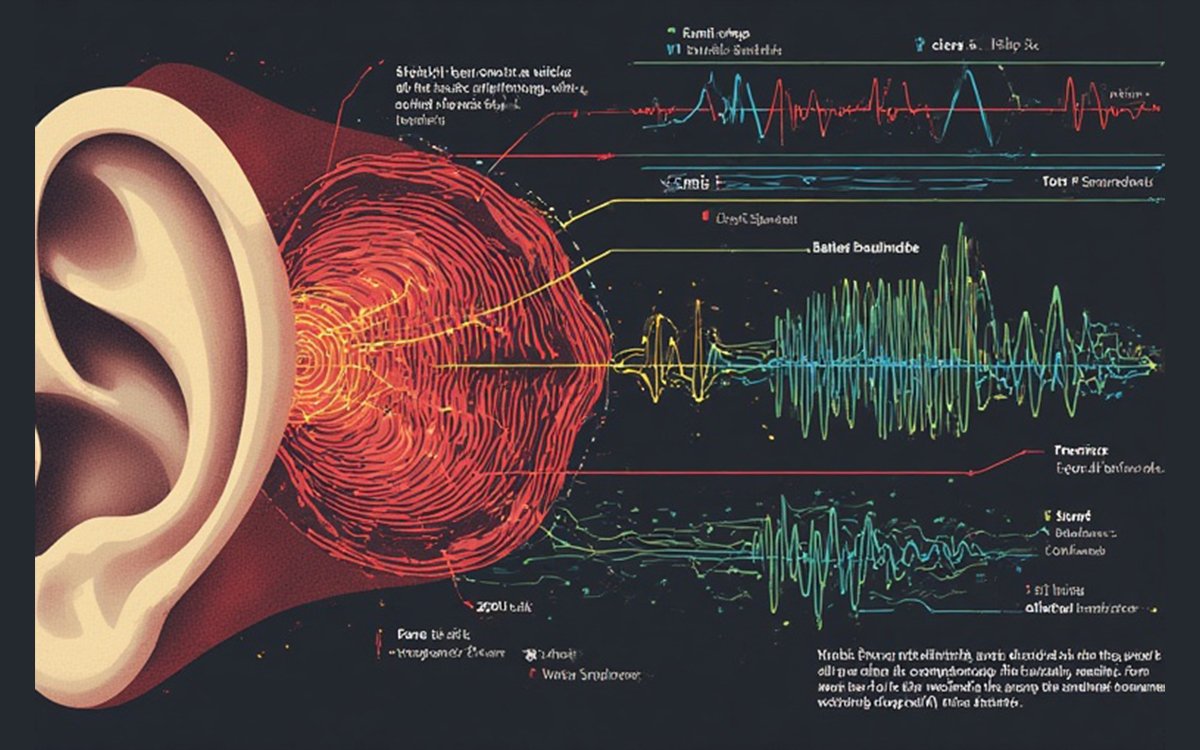
The Auditory Brainstem Response (ABR) is a crucial objective assessment of auditory circuit integrity, extensively utilized in clinical audiology and research. It captures the neuronal activity produced along the auditory nerve and brainstem nuclei in reaction to sonic inputs. The resultant waveform comprises a sequence of peaks, designated I through V, each signifying the coordinated activation of neuronal generators at various anatomical levels—from the distal segment of the auditory nerve (wave I) to the inferior colliculus (wave V). ABR testing yields essential insights into hearing sensitivity, auditory nerve functionality, and neurological condition, rendering it vital in diagnostic audiology, neonatal hearing assessment, and intraoperative surveillance.
The precision and dependability of ABR predominantly hinge on the nature of the auditory stimulus utilized. Diverse stimuli—such as clicks, tone bursts, and chirps—provoke responses that differ in morphology, latency, and amplitude. Comprehending the interaction of each stimulus with cochlear and brain mechanics is essential for enhancing test results and clinical interpretations.
Click Stimulus in ABR
The click stimulus has historically been the preferred option for ABR assessments. It is a wideband signal of very brief duration (usually 100 microseconds) encompassing a broad spectrum of frequencies, primarily between 2 and 4 kHz. When delivered at moderate to high intensity levels, the click concurrently stimulates a large area of the basilar membrane. The high-frequency portions of the cochlea respond more rapidly than the low-frequency sections due to traveling wave mechanics, resulting in the most synchronized neuronal firing occurring in the basal turn of the cochlea. The synchronous neuronal activation produces a pronounced ABR waveform characterized by distinct, reproducible peaks, especially wave V, which is the most clinically significant component.
Nonetheless, the broadband characteristic of the click restricts its frequency specificity. A click ABR can ascertain the presence or absence of auditory function, but it cannot precisely delineate the configuration of hearing thresholds across frequencies. Consequently, it is generally employed as a screening instrument or as an element of a whole diagnostic assessment rather than as a frequency-specific evaluation.
Tone Burst Stimulus: Frequency-Specific Approach
The tone burst stimulus was introduced to acquire additional frequency-specific information. A tone burst comprises a brief sinusoidal signal centered at a designated frequency (often 500, 1000, 2000, or 4000 Hz), formed by rise and fall periods determined by windowing functions like Blackman or cosine-squared envelopes. This shape reduces spectrum splatter and enhances frequency resolution.
The tone burst auditory brainstem response (ABR) offers enhanced threshold estimates at specific frequencies, rendering it especially beneficial in juvenile and challenging groups where behavioral audiometry is impractical. The response amplitude of tone burst auditory brainstem response (ABR) is often diminished and the latency extended relative to click ABR, as the stimulus engages a more restricted cochlear area and recruits fewer synchronized neuronal units. Moreover, as frequency diminishes, neuronal synchronization wanes, and waveforms become increasingly indistinct—particularly below 1000 Hz—due to the temporal dispersion of the traveling wave.
Notwithstanding its constraints, tone burst auditory brainstem response (ABR) continues to be the benchmark for frequency-specific electrophysiological threshold assessment. It enables doctors to create an electrophysiologic audiogram that closely aligns with behavioral thresholds, particularly when employing calibrated normative correction factors.
Chirp Stimulus: Concept, Variants, and Mechanism
The chirp stimulus signifies a notable progression in ABR technology, aimed at resolving the issue of temporal dispersion associated with conventional stimuli. The cochlea’s high-frequency areas at the base are stimulated before the low-frequency regions at the apex due to the traveling wave delay along the basilar membrane. As a result, when a brief broadband click is introduced, the ensuing neural responses from various cochlear regions manifest at slightly varying intervals, resulting in desynchronization and diminished overall loudness.
The chirp stimulus was formulated to mitigate this delay. By implementing a precise temporal delay for each frequency component in the stimulus, the chirp guarantees that all areas of the cochlea are activated such that their neural responses reach the brainstem concurrently. This leads to improved neuronal synchronization and, as a result, increased ABR amplitudes, especially for wave V.
The initial chirp concept was proposed by Dau et al. and subsequently enhanced by Elberling and Don as the CE-Chirp (Compensated Ear-level Chirp). Subsequent advancements have yielded versions including the LS-Chirp (Level Specific Chirp) and Narrowband Chirps, each tailored for distinct intensity levels or frequency ranges. The LS-Chirp modifies the temporal configuration of the chirp in accordance with stimulus intensity, since the cochlear traveling wave delay varies with level. Narrowband chirps are engineered to focus on particular frequency ranges, facilitating frequency-specific auditory brainstem response (ABR) evaluation akin to tone bursts; however, they yield enhanced neuronal synchronization and increased response amplitudes.
Comparison Between Click and Chirp Stimuli
Comparing click and chirp stimuli reveals some significant physiological and practical distinctions. The click stimulus stimulates the entire cochlea nearly simultaneously, resulting in pronounced synchrony in the basal (high-frequency) areas, while causing desynchrony in the apical (low-frequency) regions due to temporal dispersion. This leads to diminished amplitude and inadequate representation of low-frequency neuronal activity. The chirp stimulus alters the typical sequence of cochlear activation by delivering low-frequency components before high-frequency components. This temporal adjustment enables neural activity from various cochlear regions to reach the brainstem concurrently, markedly improving wave amplitude and clarity.
Multiple investigations have shown that chirp-evoked auditory brainstem responses (ABRs) display much bigger wave V amplitudes—frequently two to three times greater—than click-evoked responses at equivalent intensity levels. Moreover, wave V latencies with chirp stimuli are generally marginally reduced due to the synchronized summation of neuronal activity resulting in an earlier peak. These attributes render chirp ABRs more discernible, especially in acoustically challenging clinical settings or in individuals with diminished signal-to-noise ratios, such as infants.
Notwithstanding these benefits, specific considerations persist. The broadband chirp stimulus can occasionally obscure frequency-specific hearing loss due to its extensive spectral range. Consequently, although it delivers robust answers, it may not accurately pinpoint hearing thresholds across various frequencies. Narrowband chirps have been created to merge the frequency specificity of tone bursts with the synchronization advantages of chirps.
Clinical Advantages of Chirp-Based ABR
The improved synchronization afforded by chirp stimuli presents numerous clinical advantages. Chirp-based automated ABR (AABR) systems in newborn hearing screening have demonstrated a reduction in test duration and an enhancement in pass rates, attributed to increased response amplitudes and superior signal-to-noise ratios. The more robust waveforms provide enhanced automatic detection techniques, reducing the probability of ambiguous outcomes.
In diagnostic contexts, chirp stimuli enhance waveform clarity, aiding in the detection of early and late waves, which is especially beneficial for evaluating brain conduction delays or retrocochlear disease. The enhanced reliability of responses also aids intraoperative monitoring, where swift and consistent waveforms are necessary despite fluctuating physiological circumstances.
In patients with sensorineural hearing loss, particularly those exhibiting steeply sloping audiograms, chirp stimuli may still produce discernible responses when click stimuli do not elicit detectable activity. Furthermore, as chirps amplify low-frequency elements, they yield a more equitable depiction of cochlear activity, hence delivering enhanced diagnostic information relative to clicks.
Practical Considerations and Limitations
Although chirp stimuli offer distinct benefits, physicians must acknowledge their limitations. The increased amplitude may not always relate to higher frequency specificity, especially with broadband chirps. Consequently, when threshold estimation at discrete frequencies is necessary, tone burst or narrowband chirp stimuli are favored. Moreover, chirp parameters—specifically duration, intensity, and ear calibration—must be meticulously aligned with normative data to guarantee proper interpretation.
Moreover, individual differences in cochlear mechanics, particularly in those with atypical cochlear function, may disrupt the temporal connections essential for the synchrony of chirps. The efficacy of chirp compensation may differ among populations, such as those with auditory neuropathy or conductive diseases, where neuronal synchronization is fundamentally impaired.
Summary and Clinical Implications
Although chirp stimuli offer distinct benefits, physicians must acknowledge their limitations. The increased amplitude may not always relate to higher frequency specificity, especially with broadband chirps. Consequently, when threshold estimation at discrete frequencies is necessary, tone burst or narrowband chirp stimuli are favored. Moreover, chirp parameters—specifically duration, intensity, and ear calibration—must be meticulously aligned with normative data to guarantee proper interpretation.
Moreover, individual differences in cochlear mechanics, particularly in those with atypical cochlear function, may disrupt the temporal connections essential for the synchrony of chirps. The efficacy of chirp compensation may differ among populations, such as those with auditory neuropathy or conductive diseases, where neuronal synchronization is fundamentally impaired.
Discussion
0 Comments
No comments yet
Start the discussion with a question, reflection, or clinical perspective.
Leave a reply
Share a thoughtful response or ask a question about this article.