
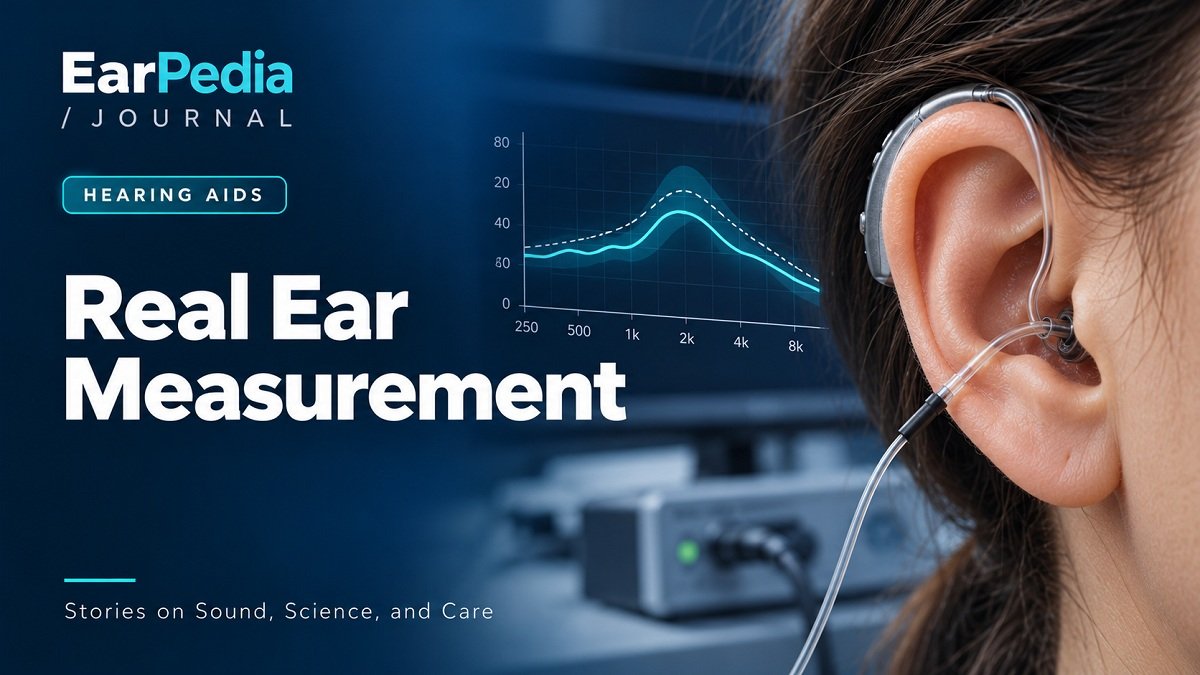
Real Ear Measurement
Introduction
Real Ear Measurement (REM) is a clinical approach employed by audiologists to validate and enhance the efficacy of hearing aids for specific individuals. This entails quantifying the auditory levels within the patient’s ear canal to verify that the hearing aids provide appropriate amplification according to their individual hearing profile. This procedure is regarded as the benchmark for validating hearing aid fitting, guaranteeing that the devices deliver the appropriate level of amplification for speech and ambient noises.
Why Real Ear Measurement is Important:
- Individualized Fitting: Every ear canal is unique in shape and size, affecting how sound is delivered and perceived. REM accounts for these individual differences, offering a more personalized fitting.
- Accurate Amplification: The prescribed amplification levels based on an audiogram may not always translate to real-world performance. REM helps audiologists confirm that the hearing aid is providing the right amount of amplification at various frequencies in the patient’s ear.
- Verification of Hearing Aid Performance: REM verifies that the hearing aid is functioning as programmed and that the patient is receiving the necessary amplification for their specific hearing loss. This is especially crucial for ensuring speech clarity, comfort, and overall satisfaction.
- Evidence-Based Practice: REM is supported by research and clinical guidelines as a key procedure for ensuring that hearing aids meet the wearer’s needs, particularly in improving speech understanding and reducing discomfort from excessive amplification.
How Real Ear Measurement Works:
- Probe Tube Insertion: A small, soft probe tube is placed inside the patient’s ear canal. The tube is connected to a microphone and is used to measure the sound levels inside the ear canal when the hearing aid is worn.
- Hearing Aid Placement: Once the probe tube is correctly positioned, the patient wears their hearing aid. The probe microphone will record the amplified sound that the hearing aid delivers into the ear canal.
- Sound Stimuli Presentation: The audiologist presents various sound stimuli, often including speech, through loudspeakers in a controlled environment. The probe tube measures the sound pressure level (SPL) generated inside the ear canal when these sounds are played.
- Measurement and Comparison: The real-ear measurements are displayed on a screen, showing the actual amplification provided by the hearing aid. These results are compared with the target amplification levels that are based on the patient’s hearing prescription (often derived from fitting formulas like NAL-NL2 or DSL).
- Adjustments: If the measured amplification does not meet the target, the audiologist adjusts the hearing aid’s programming (e.g., gain, compression) to match the prescribed levels across different frequencies. This ensures that the hearing aid is delivering the correct amount of amplification.
Key REM Terms:
- Real-Ear Unaided Response (REUR): The sound pressure level in the ear canal without a hearing aid. This serves as a baseline measurement.
- Real-Ear Aided Response (REAR): The sound pressure level in the ear canal with the hearing aid in place and turned on. This shows how much amplification the hearing aid is providing.
- Real-Ear Insertion Gain (REIG): The difference between REAR and REUR, representing the actual amplification provided by the hearing aid.
- Real-Ear Occluded Response (REOR): The sound pressure level in the ear canal with the hearing aid in place but turned off. This helps assess how much sound is being blocked by the hearing aid.
Benefits of Real Ear Measurement:
- Objective Verification: REM is an objective test that doesn’t rely on patient feedback, making it highly accurate and reliable for fine-tuning hearing aids.
- Improved Patient Satisfaction: By ensuring that hearing aids are correctly amplifying sounds according to the patient’s hearing loss, REM leads to better outcomes in terms of speech understanding and overall satisfaction.
- More Efficient Fittings: REM allows audiologists to make precise adjustments during the fitting process, reducing the need for multiple follow-up appointments.
- Enhanced Speech Clarity: REM ensures that speech frequencies are adequately amplified, improving the wearer’s ability to understand conversations, especially in noisy environments.
How Audiologists Use REM in Practice:
- Initial Fitting: During the first fitting of hearing aids, audiologists use REM to ensure the hearing aids provide the prescribed amplification at various frequencies. This helps verify that the hearing aids meet the patient’s specific hearing needs.
- Troubleshooting: If a patient reports issues with their hearing aids, such as discomfort, poor sound quality, or difficulty hearing speech, REM can help pinpoint the problem and guide adjustments to the hearing aid’s programming.
- Verification After Adjustments: After making any programming adjustments, audiologists re-check REM to confirm that the hearing aids now meet the correct amplification targets.
Fitting Formulas Used with REM:
- NAL-NL2: A commonly used fitting algorithm designed to maximize speech intelligibility while maintaining a comfortable listening experience. It aims to balance audibility and listening comfort.
- DSL (Desired Sensation Level): Often used for pediatric fittings, DSL focuses on providing audibility of speech sounds across frequencies, ensuring that softer sounds are audible while avoiding discomfort from louder sounds.
Limitations and Challenges:
- Probe Tube Placement: Incorrect placement of the probe tube can lead to inaccurate measurements. The audiologist must ensure the tube is positioned close enough to the eardrum but without causing discomfort.
- Patient Movement: The patient must remain still during the measurements to ensure accurate readings.
- Not Widely Used in All Clinics: Despite being the gold standard, some clinics may not use REM regularly due to the time involved or lack of equipment, which can affect the quality of fittings.
Conclusion:
Real Ear Measurement is a crucial instrument for audiologists to guarantee that hearing aids deliver appropriate amplification tailored to the patient’s own ear architecture and hearing loss characteristics. It augments the precision of hearing aid fittings, boosts speech comprehension, and ultimately results in increased patient satisfaction. By integrating REM into their practice, audiologists may provide more accurate, evidence-based hearing aid fittings that yield optimal results.



Discussion
0 Comments
No comments yet
Start the discussion with a question, reflection, or clinical perspective.
Leave a reply
Share a thoughtful response or ask a question about this article.